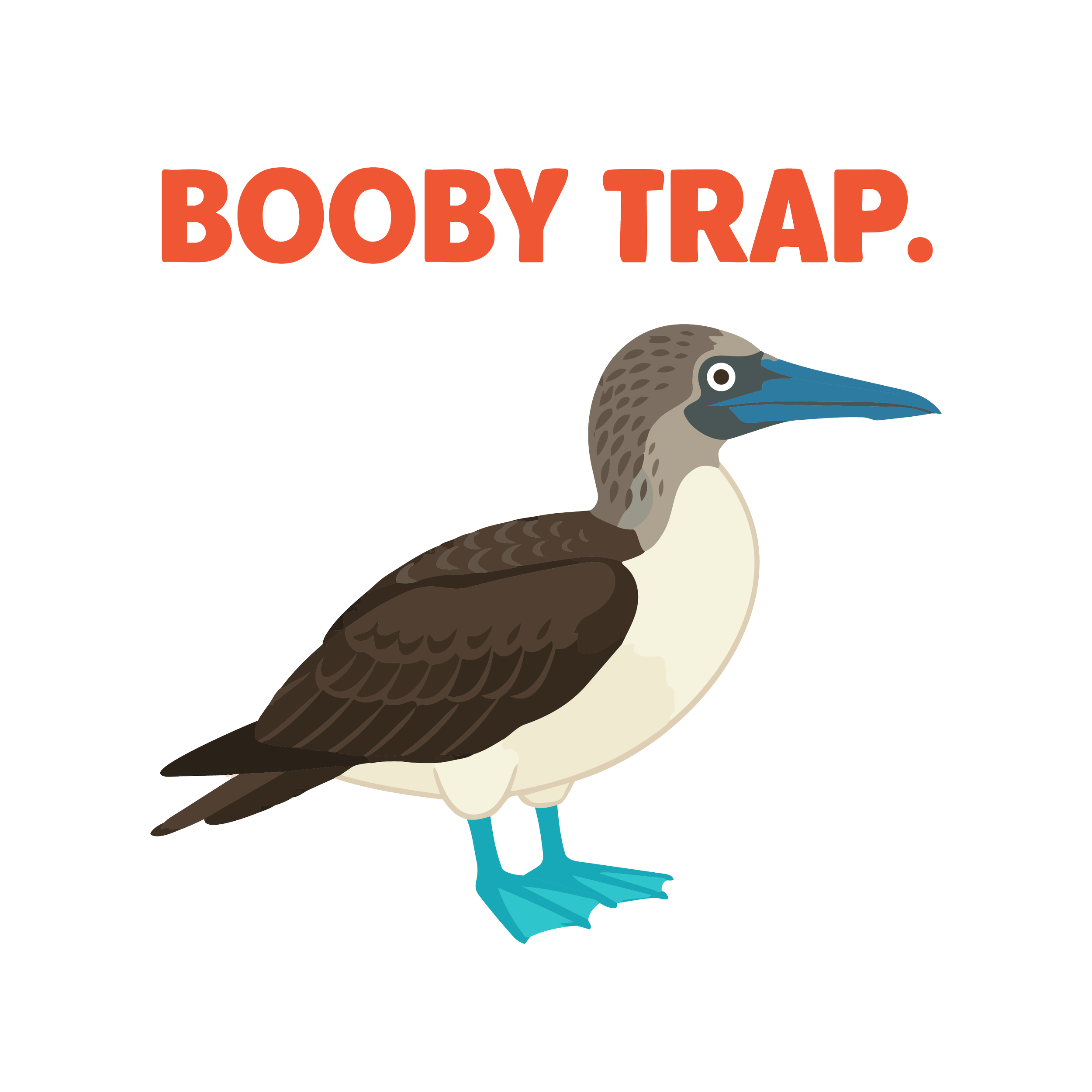
EP25: Okay, but… boobies!
LISTEN OR WATCH ON:
Release Date: June 4, 2026 The blue-footed booby has become an internet personality: cartoon feet, a goofy strut, a name that practically begs to be a punchline. But Scott sat down with Dr. Carlos Zavalaga, Universidad Científica del Sur, and one of the people who first taught him how to study seabirds in Peru, and the "fool" reputation falls apart fast. Get a booby in the air or underwater and you're watching one of the most specialized hunters in the bird family tree.
-
In this episode:
How six-plus booby species carve up the same ocean without starving each other out
What 20 years of GPS loggers, depth tags, and bags of fresh fish revealed about who eats what
Why El Niño, avian flu, and overfishing keep stacking the deck against these birds
-
00:00 - The Stress of Travel
02:05 - The Diversity of Boobies
09:26 - Field Work and Discoveries with Blue Footed Boobies
18:31 - Exploring the World of Boobies: Differences and Hybrids
26:08 - The Importance of Boobies in Peruvian History
29:01 - The Impact of El Niño on Marine Ecosystems
Timestamp Disclosure
These timestamps were generated using AI and may contain errors or omissions. They are provided for accessibility and reference purposes only and may not perfectly reflect the original audio. -
ere was like the beginning of my studies with boobies.
So my first contact with boobies, I was studying other seabirds before that date or that year. But the movies were like, you know, part of the landscape for me.
It's like I was just, you know, working with cormorants and the movies were on the back of the background, you know, in the landscape. So which is watching them just from distance, you know.
But in Lobos, one day I was working for an institution here in Peru and my work was to count sea lions on Lobos de Tierra island in northern Peru.
So I landed on the island for first time and my first impression was just watching the blue footed movies because they were all over the place who were not scared of humans so you could walk beside them without any problems. And I said, someday I will come back. And it was true.
So I met a person in Mexico who was building this small GPS to be used in zippers mainly, and from Italy. His name is Giacomo, who was with us in the. In the.
And it was an anecdote, you know, because I was a PhD student in the US and I, you know, was in this meeting and so I met Giacomo and I said, oh, Giacomo, how are you? I said, oh, yeah, I study blue. Well, I would like to study blue footed movies, but I don't have money. And I.
And he said, no worries, give me a date and a place to land on Lima and I will go with you. And that was it. So he brought the GPS and he brought everything. He taught me how to use them.
For first time, first question we had was, okay, the blue footed boobies are found usually in tropical waters. Right. So in Panama, southern Mexico, et cetera.
And what they are doing here in Peru, of course, they are in Lobos de Tierra island, which is in northern Peru, but still under the influence of the Humboldt current.
Dr. Scott Taylor Yeah, the water is still very cold there, right?
Dr. Carlos Zavalaga Yeah, still within the Humboldt Current realm. And my first question was, are they going offshore to tropical waters, you know, outside the Humboldt Current waters.
They are feeding on tropical fish species, not anchovies. And this was the first question we had and that was a magnificent opportunity.
Opportunity for testing this because the blue footed boobies were actually breeding in a system. So let's do it. And we did it. And we find out that the blue footed boobies were feeding inside the Humboldt Current and feeding on anchovies.
So that was very new for us. Very new.
Dr. Scott Taylor Yeah. And so that was before I went. So was Giacomo was with us when I went out.
I remember he bought that trumpet in Lima to learn how to play the trumpet out on the island. What a nice guy. But can you talk to everyone about how you figure out what they're eating?
Because I was, I helped with this a bit when I was out there too, but it's kind of gross.
Dr. Carlos Zavalaga Yeah.
Dr. Scott Taylor Okay.
Dr. Carlos Zavalaga Okay, that's interesting. Usually when you grab a booby to, you know, attach a GPS logger, for example, you need to grab it. So you use a long pole.
Sometimes you can just do it with your hands. Of course you need to use a glove because the bill of any booby organette is very dangerous. They have serrated and they are very sharp.
It's very dangerous. Okay. So you need to use gloves, of course.
Nazca boobies in the Galapagos, I grab them from the bill, just extend my hand and grab them from the bill without any problems. And if they are returning from a foraging trip, they immediately regurgitate. So you don't need to do anything, it's just the act of grabbing them.
Yeah, you know, makes that they can. They regurgitate all the food. So you have all the anchovies, all the fish they feed on during that time, that trip.
So we were collecting those and then putting in bags and then because we needed to, you know, grab 10, 12, 15 boobies in a row. So we return it to our station with 15 bags of food, 15 bags.
Dr. Scott Taylor Of booby vomit that you then had to sort through.
Dr. Carlos Zavalaga You know what, they were fresh.
Dr. Scott Taylor Yeah, it's not that gross. I mean, it's not the.
Dr. Carlos Zavalaga Not so smelly, you know.
Dr. Scott Taylor Yeah, I mean it's still oily fish, even though it's fresh. Oily fish. But I'm pretty sure some of the clothes I wore when I was out there had fish stains like for the rest of time until I got rid of it.
Dr. Carlos Zavalaga I can imagine, you know, you coming from genetic lab, you know, very. Everything you know is very Pristine and clean, you know, and coming for first time to a guano island when is everything is the opposite.
You know, traveling in fishermen boats, they are not clean at all. You know, working with the boobies and the wano and the ticks and then the vomits. It was very traumatic for you, for sure.
Dr. Scott Taylor It was definitely what I describe now as type two fun. Yeah, I was definitely stressed out a lot of the time. I think it was my first trip outside of, like, North America proper.
And then I'm on these guano islands covered in ticks. I remember when we got to Lobos de Tierra, I guess, because we'd been in the boat for 14 or 15 hours at that point, and it was morning.
We did the sampling and I went to lay down and I was in that little hut, and I remember feeling like I was being watched and looking over on the pillow and there were like five giant adult ticks just slowly walking towards my head. And I was like, nope, absolutely not. I'm not going to nap.
Dr. Carlos Zavalaga Yeah. Oh, man. Okay.
Dr. Scott Taylor Even just using a rope ladder to get onto some of those islands was, like, the first time I'd ever used a rope ladder.
It's hard to paint a picture for people listening, but for some of these islands, like, you have to go up to a dock that was originally built for, like, the guano ships that would collect bags of guano. And like, the rope ladder, I feel in my head it was 35ft, but maybe it wasn't that long, but it was a long rope ladder.
Until I get onto that out of a boat that's moving in, you know, the surf, and then climbing up a rope ladder, which, if you're listening, you don't use, like a normal ladder. You have to climb up with the ladder, like, between you. It's hard to describe. But anyways, lots of firsts for me on that trip. Definitely.
Dr. Carlos Zavalaga Yeah. Sorry, Scott.
Dr. Scott Taylor No, don't apologize. I had a great time. I mean, it was definitely character building. And I think fondly about the guard on Lobos de Fuera who would give us mangoes.
That was pretty clutch for my mental health.
Dr. Carlos Zavalaga Fresh fish as well.
Dr. Scott Taylor Yeah. I mean, the ceviche was amazing.
Dr. Carlos Zavalaga Yeah. I don't remember until today having so high infestation of ticks. There were millions of them and they were crawling over your body.
So we needed to take the blood sample with all the ticks on us, you know, and then we finished. All of us ran to the dock and jumped off the water.
Dr. Scott Taylor Yeah.
Dr. Carlos Zavalaga With all our clothes on.
Dr. Scott Taylor Yeah.
Dr. Carlos Zavalaga I mean, we didn't care. How high was the dock to the water? We didn't care. So we just jumped.
Dr. Scott Taylor No. Yeah, that was probably the highest I've ever jumped into water from. And also the water was very cold.
For anyone who sing the Humboldt Current is cold water. It is very refreshing. Almost takes your breath away. But yeah, that's funny that that was like the tickiest it's ever been.
I thought that was just like, I mean, I guess lobo stuff wear Tahira weren't as ticky. But for folks listening, seabirds can get a lot of these ectoparasites, right.
They're living in these really dense colonies which is a great place for things like ticks and other parasites to live. But yeah, I've never seen that many ticks in my life.
And they're different than the ticks that people in North America might be familiar with where we have these hard bodied ticks that you can't really kill. These ticks are soft bodied or gassed ticks and you can squish them which is really satisfying.
But when there's 10,000 of them on your arm, you can't squish all of them. Yeah.
Dr. Carlos Zavalaga Particularly when you are focused on taking blood.
Dr. Scott Taylor Yeah, yeah.
Dr. Carlos Zavalaga You cannot move so you need to be very precise and you know all the, you know in your face or everything. So it's, it's. Well that's the way that was the way.
Dr. Scott Taylor Yeah, that's the way we got through it.
We found out some cool things about the fact that blue footed and Peruvian boobies hybridize and they have this really interesting population structure and all of that. And yeah, we're even, you know, revisiting all of this work with whole genomes now.
And Danny Jackson is leading this cool new paper about booby phylogenomics. So I'm excited for that to come out soon.
I think most people probably are more familiar with blue footed boobies because they have these bright blue feet and they do these funny displays. How does the, the appearance and the, the behavior of the Peruvian booby differ?
Dr. Carlos Zavalaga Yeah, this is more like cartoon, you know.
Dr. Scott Taylor That's awesome. I wish I had one of those.
Dr. Carlos Zavalaga But it has the necessary feature to show you what makes the difference between Peruvian booby and blue footed booby. And one of them is the size. The blue footed boobies are slightly larger than Peruvian booby.
In average a Peruvian booby can weigh I would say 1300 grams, 1.3 kilograms, whereas an average of the Peruvian booby is 1.6, 1.7. Maybe this is One of the differences, the other one is the sexual dimorphism. In boobies, females are larger than males.
So this is something not very common in nature, particularly in birds where the males are usually larger than the females or they are similar. But in boobies the female are larger. Well, in the blue footed booby, the female is much larger than the male than in the Peruvian booby.
What it means, it means that when you are in a blue footed colony, just by the size, you can recognize or discriminate between a female and a male. But when you are in a Peruvian booby colony, that's more difficult, it's much harder. Harder.
And another characteristic is the color of the iris, the eye. See, it's red wine in the Peruvian booby. Red wine, yeah.
Dr. Scott Taylor Carlos is holding up a little figurine of each of the booby species. If you're listening and not watching. And yeah, the color of Peruvian booby eyes is the color of red wine. A beautiful, really amazing color actually.
Dr. Carlos Zavalaga It's well represented here.
Dr. Scott Taylor It is, yeah.
Dr. Carlos Zavalaga Yeah.
Dr. Scott Taylor That's an awesome sculpture.
Dr. Carlos Zavalaga Whereas the, the blue footed booby is yellow.
Dr. Scott Taylor Yellow, yeah.
Dr. Carlos Zavalaga That's quite different.
Dr. Scott Taylor Yeah. And very satisfying that when they hybridize, the hybrids have orange eyes. The perfect combination.
Dr. Carlos Zavalaga Yeah, it's amazing. Exactly. Yeah, that's amazing. And yeah.
And when you are in a blue footed booby colony and also in the Peruvian booby colony, you will, you will hear in the colony the background noise, the boobies and you will hear grunts, but also whistles. So you will hear something like. But also you will hear. So this is because the females grants in both species.
Dr. Scott Taylor Both species.
Dr. Carlos Zavalaga Whereas the males whistle.
Dr. Scott Taylor Yeah.
Dr. Carlos Zavalaga So I think that's the main. There are other differences of course, but I think they are the main ones. Of course. The color of the feet, this is pretty obvious. Right?
And movies of course is blue. But they have different tones of blue.
Dr. Scott Taylor Yeah. Depending on their carotenoids. Right.
So I guess the color of the eyes is related to carotenoid coloration, which we've talked about on a previous episode as well. Whereas the color of their feet is the same. This cool combination of carotenoids and structural blue.
Dr. Carlos Zavalaga Right, yeah. And it's used as a measure of quality for sexual selection. In this species. The Peruvian boobies, they have a gray, gray feet.
And in the hybrid you will find the gray feet, but there are dots of blue.
Dr. Scott Taylor Little blue patches.
Dr. Carlos Zavalaga Yeah, like the perfect hybrid, the blue footed and the Peruvian booby.
Dr. Scott Taylor Yeah, it's exactly what you'd expect if you mix the two Together.
And that red coloration of the Peruvian booby's eyes is probably also carotenoids, but ones that have been modified to be red instead of yellow, which is pretty impressive. Yeah, I love them. They're such awesome birds.
What has been kind of surprising about them for you or what have you come to realize about like the difficulty of life for a seabird from studying boobies specifically, you know, when, when you.
Dr. Carlos Zavalaga Study them deeply and you find out some special features of them that makes them so different. The blue footed boobies dive deeper than the Peruvian boobies, for example. This is one major difference.
And when I studied the Nazca boobies in the Galapagos, I was trying to get records of deaths because I, I thought, okay, this is a bigger booby and they should dive deeper, you know, because if they use the momentum of the fall, the heavier you are, the deeper you will attain in the water of the culling water. So I was tagging Nazca boobies in the Galapagos Islands to find out how they dive.
And when I recovered the loggers, I found out that something was wrong.
And I thought that the loggers were not working because really, you know, I found for example, 5 dives or 6 dives of less than 1 meter in 13 hour trip while the blue footed boobies can make 50, 70, 100 dives in less than 2 hours or at the most 3 hours. And honestly I thought my loggers were not working at all.
But then I found out for first time that one possibility was that they were catching the prey in the air. But by that time I didn't know that, so was not a very common finding.
But then having all these pieces like, you know, very few dives, not so deep, very shallow dives and returning with flying fish in their stomachs.
So make me think that that would be a possibility then, you know, with the use of, of small video cameras, I'm talking about 15 years later, 20 years later. Yeah, yeah. Was confirmed that in fact they feed on flying fish in the air.
So that was the reason why I didn't get too many dives for this large booby, you know. Yeah, yeah. So this is some of the, you know, the differences I found and why I am still working with the movies. There is another reason too.
The boobies in Peru played a so important historical role because the movie together.
Dr. Scott Taylor With.
Dr. Carlos Zavalaga One Eye Cormorant and the Peruvian Pelican are guano producers.
For those who are not familiar of guano, guano is, you know, it's the dropping of seabirds and here in Peru they accumulate built up in large amounts.
I'm talking about tens of thousands of tons accumulated on the surface of the island because we have large numbers of Peruvian boobies, one eyed cormorants and Peruvian pelicans. And the government harvest this guano every five, six years on different islands to be all as an organic fertilizer.
And in Peru we have this tradition since the Inca times. So the Inca.
Dr. Scott Taylor Yeah, it's incredible.
Dr. Carlos Zavalaga Yeah. And the bubies and the cormorants were not painted, but they were represented in the walls of the temples of ancient civilizations here in Peru.
So Peruvians are very, very familiar. And we are or the coastal population live in close association with the Peruvian boom since historical, ancient times.
And this is why, from my point of view, it's so important to study them because they still play an important role in the ecosystem, provide services like guano, for example.
But now or today they are suffering the consequences of different pressures like avian flu, recurrent and more frequent El Nino pollution, invasive species on the island, rats, cats, et cetera. So the populations are decreasing. So now I, I'm very interested to know how to solve all these problems.
Dr. Scott Taylor Yeah, history is amazing. Like the history of the guano industry and how much money was made off of poop from birds.
Like, for folks listening, it's hard to overstate the importance of the guano industry to Peru as a country historically, I mean, and contemporarily back before we had the ability to make ammonium, basically before the Haber Bosch process was discovered, natural bird guano in places like Peru and then just a few places in the United States was this really important source of nitrogen for both fertilizer and gunpowder production. And so the Humboldt current is this, we've alluded to it. It's for me, it's the most impressive marine ecosystem I've ever witnessed.
It's like the richest, most full of life place, you know. Could you walk us through what happens when there's a really strong El Nino?
So when you have warm water instead of cold water, what does that do to the birds? And you just alluded to the fact that these El Nino events are becoming more frequent and more intense.
So what impact is that having on, on Peruvian boobies?
Dr. Carlos Zavalaga I think the sea surface temperature increase is the most notorious. Why?
Because the anchovy, which is the main, you know, or the keystone prey in the whole ecosystem, is they don't like warm water, they live in cold water and when El Nino arrives, they disperse to cold water or they are Going deeper in the water. So they are far away from their predators, including boobies, cormorants, penguins, whatever the consequence is.
This is a severe drop of the population number. So very severe. Severe. So from millions to maybe hundred thousands. Okay.
Dr. Scott Taylor Wow.
Dr. Carlos Zavalaga And after El Nino, usually in the past, you have a period of time for the population to recover before the next El Nino arrives. In the last 20 years, for example, we have witnessed at least 12 El Nino between years. 12.
Dr. Scott Taylor That's more than historical.
Dr. Carlos Zavalaga Yeah, of course. And this year we have another one.
Dr. Scott Taylor This year is going to be a big one, right? Yeah.
Dr. Carlos Zavalaga And we had one big one two years ago, so. So the birds are trying, of course, of do their or follow their instincts. Right. They don't think that El Nino is coming.
They just found the conditions breeding as crazy and trying to recover, you know, have this pattern and still have more anthropogenic pressure, like, for example, overfishing, avian influenza, pollution, et cetera, et cetera, et cetera. This, you know, pattern is still more sharp.
Dr. Scott Taylor Yeah, that downward trend will continue.
And we did talk about on a previous episode of the podcast Avian flu, which has hit Peruvian boobies pretty hard in Peru, along with other seabird species along the coast of Peru. They've experienced pretty strong declines because of avian flu.
And then again, the anchovy fishery off the coast of Peru is incredibly important economically, and it's in direct competition with the birds for the food that they need for their chicks. So, yeah, there's a lot more anthropogenic stressors on that species now than there were historically.
We've reached the part of the show that we call that's BS or that's bird stuff, where we give our guests an opportunity to debunk a myth that ruffles their feathers. So, Carlos, what do you want to.
Dr. Carlos Zavalaga Call BS on Some people think that boobies are incubating their eggs with their bellies, but actually what they do is use their feet.
Dr. Scott Taylor Really?
Dr. Carlos Zavalaga Yeah. To heat their eggs during incubation.
So if you have the chance to check a booby nest with eggs, and you will see that they are protected by the webs of the feet very carefully over the eggs to transfer the heat from the body to the eggs.
This is why the feet of the webs and feet of the boobies are very, very full with arteries, and that's because they use them for heat transfer to the eggs.
Dr. Scott Taylor That makes total sense. I hadn't thought about that.
And I've even seen these birds in the wild, but a lot of birds develop what we call a brood patch where they lose their feathers and then they have gross looking really heavily. Yeah. Wrinkled skin that they put on their eggs to keep them warm.
But if you're a seabird diving into cold water, that would be really bad to have a huge exposed part of your belly. So very cool that they use their their feet to incubate. That's awesome. I really appreciate you joining us today to talk about boobies, Carlos.
I look back on our time in fondly and I tell those stories to a lot of folks. So it's fun to revisit them and also get to chat more about boobies and how cool they are. So thanks for joining us today on the podcast.
Dr. Carlos Zavalaga Thank you. A pleasure to talk about boobies and be here to your audience too. Thank you.
Dr. Scott Taylor Awesome. Birds are dinosaurs and around here we like our snacks. So we end each episode with a dinosaur nugget.
Today's nugget is There are around 10 species of boobies and gannets, and at least one of them lives in nearly every ocean on earth except the waters around Antarctica.
They get their name from the Spanish word for bobo because sailors saw them being clumsy on land and didn't bother to watch what they did in the water.
The next time someone calls a booby a dummy, you can let them know they're insulting one of the most impressive hunters in the entire bird family tree. That's a wrap on this week's episode: Okay, but... boobies! What other okay, but birds questions do you have? Leave us a comment and let us know.
And leave a rating or like, while you're down there, we'll catch you next time. Bye. Okay, But... Birds is hosted by Scott Taylor, with production and creative by Zach Karl.
Transcript Disclosure
This transcript was generated using AI-assisted transcription and may contain errors or omissions. Please refer to the audio or video episode for the most accurate representation. -
All audio, video, and images in this episode are either original to Okay, But... Birds (© Okay Media, LLC) or used under license/permission from the respective rights holders. Bird media from the Macaulay Library is used courtesy of the Cornell Lab of Ornithology as follows:
Blue-footed Booby audio contributed by Robert I. Bowman, ML85906
Red-footed Booby audio contributed by Robert I. Bowman, ML85911
Brown Booby audio contributed by Gerritt Vyn, ML136211
Masked Booby audio contributed by Chandler Robbins, ML32604
Nazca Booby audio contributed by Oliver H. Hewitt, ML31543
Peruvian Booby audio contributed by Ted Parker, ML29399