
E39: Okay, but why does that bird look so rough?
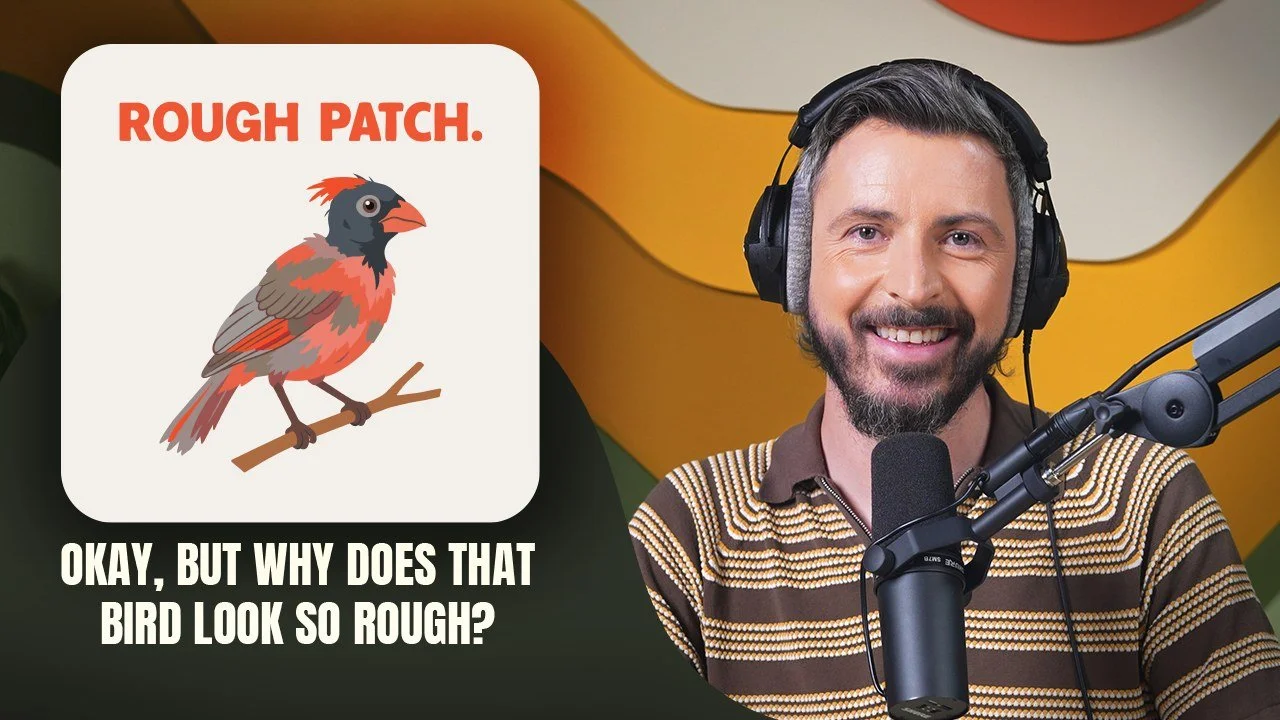
Release Date: Sep 10, 2026Every August the questions start: there is a cardinal at the feeder with no head feathers, and it looks terrible. Nothing is wrong with it. It is molting, which every bird does at least every year. Dr. Ryan Terrill of the San Diego Natural History Museum studies what a feather endures over a year and what it takes to replace one.
Transcript
In this episode
- Why cardinals and blue jays turn up at late summer feeders with bare heads, and why that is molt rather than illness
- How ultraviolet light breaks beta keratin into free radicals, and why melanin makes dark feathers wear more slowly than white ones
- Why a feather is dead the moment it finishes growing, so a bird has to replace the whole thing to change color
- Molt migration, and the western birds that stop in the desert southwest and western Mexico for the monsoon rains before finishing the trip
- Why seabirds such as the red-footed booby molt in slow overlapping waves so they never lose aerial maneuverability
- What growth bars record about how fast a feather grew, and how they differ from fault bars
Scott Taylor: Scott, what's going on with the cardinal at my feeder? Is it sick? It doesn't have a single feather on its head. Scott, where did all the goldfinches go? I always have goldfinches. Scott, the goldfinches are back. These are very common things I get asked this time each year. Sometimes it's a blue jay instead of a cardinal. The goldfinch question is remarkably consistent. Either feathers have gone missing or aren't the color one might expect. Feathers matter. We know that because the previous episode was on that very topic. So why do we keep seeing birds missing a few or missing every last one on their heads? And how does a bird change color at all? Same answer to both, molt. Our hair grows continuously, until one day it doesn't. Feathers don't work like that. A feather is done the moment it finishes growing. It cannot go from yellow to brown and back to yellow. The bird has to grow an entirely new one. And feathers break down over time, which matters a great deal when the same structures are handling insulation, waterproofing, flight, and much of how a bird communicates. The cadence with which birds replace their feathers varies enormously. Some need to be brilliant for the breeding season and invisible the rest of the year. Some are so dependent on flight that they swap out a couple of feathers at a time all year long, so there's never a gap in the wing. And some drop every flight feather at once and are more or less stuck for weeks. Which brings us to the topic of today's episode. Okay, but why does that bird look so rough? To help us unpack that, I'm joined by Dr. Ryan Terrill, Curator of Ornithology at the San Diego Natural History Museum. After the break, Ryan walks us through what a feather endures over a year and how sunlight influences feather breakdown. We get into the species that fly hundreds of miles to Mexico and the desert southwest of the United States just to grow new feathers and what happens when the rain they're counting on arrives late. And we talk about why a molting bird can't afford to be startled. Stay tuned.
Scott Taylor: Welcome back to the podcast, everyone. I'm really excited to have Ryan here today to talk all about molt. Thanks for joining us, Ryan.
Ryan Terrill: Thank you, Scott. I'm happy to be here.
Scott Taylor: Of course, yeah. So we recently talked about feathers on the podcast, and one of the truths about feathers is they need to be replaced, which is called molt. I thought we could start off just by talking about what molt is.
Ryan Terrill: Yeah, of course. I'd be happy to go through it quickly. Like you said, feathers are really lightweight, as we know. And because of that lightweight nature of feathers, they break down pretty quickly. A lot of what causes feather breakdown is ultraviolet radiation. Feathers begin to lose that function as they break down. They're not quite as aerodynamic. They can't keep air in or out. They can't keep water in and out, in or out. And, you know, within about a year, feathers get to the point where they need to be replaced. That breakdown isn't linear. You know, it's like starts to go, starts to go. And then it's like kind of all gone. Sort of like a, you know, piece of clothing. Like once it's really raggedy, it's not really very warm anymore. And so, you know, feathers last about a year and birds will... They'll drop their feather, they'll drop that old feather completely and grow in a new feather. So it's not like a process of continual growth like our hair is, nor is it a process of complete ecdysis. So like a crab's molt where it grows a new shell and crawls out of the old one and has a whole new one. Individual feathers, they drop completely and then a new one grows in its place, one at a time or multiple at a time, depending on the taxon.
Scott Taylor: Yeah, walk us through all the things that destroy a feather. So birds are replacing their feathers annually, and there's lots of things that are breaking feathers down. So tell us about kind of the laundry list of things that break down a feather.
Ryan Terrill: Well, you may not be too surprised to learn that it's still something we're learning about and trying to understand. There are a lot of things that potentially break down feathers. You know, birds have feather mites, little mites that live on the feathers. Those probably don't break down feathers too much. They're probably not eating the feather. I don't believe they're eating the feather. Feathers also have bacteria on them, keratinolytic bacteria, so bacteria that does actually eat the keratin. We don't know how much keratinolytic bacteria actually affects feather breakdown. Are they eating enough keratin for the feather to actually break down? I don't know. My guess is that... Probably not too much, especially just by the fact that like we put these birds in drawers for decades and centuries and like the feathers seem to be fine and we don't really... treat them for bacteria in any way. Of course, there's naphthalene, so maybe the naphthalene kills the bacteria. I don't know. There's physical abrasion, which clearly probably breaks down some feathers. But far and away, as far as we know, the primary driver of feather degradation is ultraviolet light. It's why we keep bird specimens in drawers and they do fine for hundreds of years. But if you leave one out by a window for like a couple weeks or a month or two, that specimen is going to be pretty destroyed. So my understanding is that what happens with ultraviolet radiation is that it strikes the beta keratin and it excites one of the bonds in the beta keratin and breaks the molecule up into what are called free radicals. And we have to deal with free radicals metabolically as well. It's a molecule that is no longer stable and instead has these open binding sites and it goes and binds to other beta keratin and where it binds there, it breaks that up. And so it takes what was once, you know, nice put together proteins and breaks them up. And then the more these free radicals are floating around, the more... destruction they cause because they just keep breaking up the molecules. And that is why dark pigments like melanin are good at keeping feathers high quality in the presence of ultraviolet radiation is because the melanin has binding sites for the free radicals. The free radicals are more attracted to melanin than they are to the other beta-keratin. Yeah, and that's why dark feathers wear more slowly than light feathers.
Scott Taylor: Yeah, and I like to think of like gull wingtips. They're always darkly colored and wingtips is what you would like to not wear away if you're trying to navigate the air.
Ryan Terrill: Yeah, and they have those white spots and often like you can see like the white is like carved out. Yeah. Somebody like took a knife and carved out the white and the black is like totally fine.
Scott Taylor: That's so cool. Cool. I didn't realize that that's how ultraviolet broke down keratin. I wonder if any like bioengineers have tried to, well, and I think the thing for folks to remember too, which we have talked about in the context of feathers is they're dead. So it's not like the free radicals can be taken care of from molecules that are actively doing anything because as the feather emerges from the feather bud, it's a dead thing. And that's why you'd have to just replace the whole thing annually if you needed to fix anything. So some birds molt gradually, so you'd never really notice. And others look like they got in some sort of fight, like these cardinals we see or blue jays we see at our feeders this time of year that have almost no head feathers. So what are some of the species with the longer, more noticeable molting cycles and what do they have in common?
Ryan Terrill: Some of the species that have the longest cycles are species that are in molt just about all year. I think the longest known molt cycle that we know about is the white-plumed antbird, Pithys albifrons, that lives in the Amazonian rainforest. Birds that seem to not live in an area that is very seasonal. Their molts may be protracted. We don't exactly know why, but there might be, you know, not a lot of selection on when the best timing to molt is. It also may be just that they want to be ready at any time of year to breed, like if there's a lot of food or a lot of rainfall or something. And so by having that sort of like an aseasonal type or pattern to their molt that may be able to take advantage of booms and resources. We don't exactly know. For seabirds like boobies, we have kind of hopefully a better idea, which is especially birds like, for example, the red-footed booby, eats a lot of flying fish and relies on like incredible aerial maneuverability. And wing molt in birds causes like a little, you know, a gap in the wing where that feather is missing and birds lose a little bit of aerial maneuverability. And so if a bird... really quickly, a lot of feathers will be missing at once and there will be a big gap in the wing. And so what boobies do and other seabirds like frigatebirds is they'll molt really, really slowly and they'll often have multiple waves of molt going out the wing at once so that there's never any big compromise. So they take that sort of... little bit of compromise in like aerial maneuverability and flight ability and kind of stretch it out through the year. So there's never one period where they're just like really bad at flying. And so there's probably like, you know, one way of having a really long protracted molt may be sort of like a relaxation of seasonality. And then another way may be just like a really highly dialed in life where your feathers have to be performing really well at all times and you can't afford to be replacing a bunch of them at once.
Scott Taylor: And that's really different from birds that migrate. Like a lot of the birds we're familiar with here in North America migrate north during the spring. They breed. And they've got to fit in their molt somewhere. So they need to fly often long distances, which means you've got to have a good set of feathers. You've got to show up on the breeding ground looking your best so that you can attract a mate. So talk a little bit about how migration constrains molt and what we see in those migratory birds.
Ryan Terrill: Sure. And some of the shortest, quickest molts we know of are in migratory birds. And that's not universal. There are resident tropical birds that have quicker molts than the white-plumed antbird for sure. And there are... migratory birds that have longer molts. But in general, especially in passerine birds, molt doesn't tend to overlap too much with breeding or migration, especially breeding. Again, there is a latitudinal gradient in molt breeding overlap. And so the farther away from the equator birds breed and the more migratory they tend to be, the less they tend to overlap molt and breeding, probably because they're both energetically expensive things to do. And then birds often don't overlap molt with migration, as you can imagine, you know, the flight performance of feathers that are compromised may make it harder to migrate. There are many species of birds that do what we call molt migration, where they'll migrate part of the way, stop, molt, and then continue to migrate. A lot of the birds that breed here in the Western United States and Canada and Western Mexico do this molt migration, where they go to the monsoonal rains in late August, early September, you know, molt their feathers and then keep going. As opposed to birds that breed in the east, they tend to do their molt before they leave their breeding ground. And that has to do with like differences in rainfall and food availability during the late summer, early fall. But yeah, so some of the highest breeding birds are birds that have the shortest molt. I think snow bunting is the bird with the shortest documented molt. It undergoes its complete pre-basic molt. 46 days or something like that. I forget the number, but yeah, those are the ones that tend to have the really short molts. But those things do break down a bit in other taxa, like seabirds. They overlap molt with migration plenty because some of them are just kind of molting all the time and they have these really extended protracted molts like we talked about with the boobies. And so... And a lot of exceptions to a lot of those rules. But in general, birds that migrate more, they have shorter molts. And they also, birds that live farther from the tropics tend to have shorter molts, especially in passerines.
Scott Taylor: Do all birds only molt once a year? Or is it multiple molts depending on the species and like what they need the feathers for? Because I don't know, thinking about a snow bunting, well, snow buntings are a weird case because they like wear into their breeding plumage versus molt into their breeding plumage. But yeah, talk about what like a pre-basic molt is, what the different kinds of molt are and the outcomes of those.
Ryan Terrill: Yeah, this is a great question. Yeah, there is variation among taxa in number of molts per year. So there are a number of birds that only molt once a year. Most birds molt at least twice in their first year of life. And then many birds only molt once a year after that. Many birds molt twice a year after that. So just to give a really basic, you know, without getting too jargony, the annual molt that replaces all the feathers. We call it pre-basic molt. So this is sort of like the basic molt produces the basic plumage. And just about all birds at least do that. They do one molt every year that replaces all the feathers. Some birds, in addition to that pre-basic molt, they have another molt that replaces some of the feathers. We call that the pre-alternate molt, and it brings about the alternate plumage. And that's usually associated with a breeding plumage. So a bird that goes between a breeding and a non-breeding plumage, the pre-basic molt will usually produce the non-breeding plumage, and the pre-alternate molt will produce the breeding plumage. And like you said, snow buntings don't have that pre-alternate molt. They just do a pre-basic molt, grows white feathers with brown tips. Those brown tips wear off through the year and they have that white plumage with just one molt. But, you know, like warblers or ducks, they might have, they'll have two molts a year. And in fact, ducks do the opposite. Their nice bright plumage actually comes from the pre-basic molt and their dull brown plumage comes from the pre-alternate molt. Migratory ducks tend to do pair bonding in the winter on their winter grounds and then migrate together to the breeding grounds. So they're in that flashy, bright, ornamented plumage in the winter. And so that pre-basic molt is that complete molt that brings about that plumage. So basic versus alternate isn't necessarily about color. It's about extent. Basic is a complete molt. Alternate is almost never a complete molt. There's three species of birds that we know of that have a complete pre-alternate. Bobolink, Franklin's Gull, and Willow Warbler. And they replace all their feathers twice a year, every year. But it's only, that's it. You know, of the hundreds of birds that, thousands of birds that have pre-alternate molt, there's only three where it's complete. And then there's another molt. So we call that alternate molt an inserted molt because it's inserted into that cycle of basic molts. Try not to get too jargony. But there's another inserted molt that's like, you can think of it as an extra molt that many birds do only in their first year. And we call that the preformative molt. The guess is that is to replace juvenile feathers. When birds are in the nest, there is a good amount of selection to leave the nest quickly because being in the nest is a really dangerous place for young to be unless you're a cavity nester. And so when birds are growing their first set of feathers, which we call their juvenile plumage, they grow really quickly. And so the feathers kind of come out like pretty low quality. And so most birds... they will immediately go through another molt right after they leave the nest. So they grow these feathers. They're just enough to get them out of the nest, get them able to fly and not sitting in this really vulnerable place. But the feathers are kind of so low quality, it's worth it to replace a bunch of them again. We call that the preformative molt, and that brings about the formative plumage.
Scott Taylor: No, that's cool. So for the preformative molt, is that more common in migratory birds that have to like go on to do a thing? Or is it like, do chickadees do that? You think I would know.
Ryan Terrill: Chickadees do it. No, it's actually, it's near universal in birds.
Scott Taylor: Okay. That makes sense because you need like, regardless of whether you're migrating or surviving a cold winter, like feather structure and function is important for fitness. And so.
Ryan Terrill: Basically, the only birds I think of off the top of my head that don't have a preformative are like ibis. I think most raptors, a few other things, but it is near universal. And we think it's probably the ancestral condition.
Scott Taylor: Clearly, molt is an energetically expensive thing, especially the way you do it. Like in these migratory birds, if they're replacing a lot of their feathers at once. But regardless, growing feathers costs something. And so have people quantified the physiological costs of molt?
Ryan Terrill: To my knowledge, there hasn't been a lot of quantification of the metabolic costs of molt. There have been some attempts looking at foraging rate, I think, and molting found little evidence that foraging rate changed. There have been some cage experiments in the 80s, I think. Mary Murphy did some work with white-throated sparrows. I think fed birds enough to survive, but not enough to molt, and they grew feathers. They molted anyway. One thing we know is that birds can't delay their molt to find food.
Scott Taylor: That's interesting.
Ryan Terrill: Yeah, they can move around and find food, but they don't seem to be able to delay molt. Mary Murphy found that, but... The strongest evidence that we have or the best kind of base of knowledge that we have about the metabolic costs or the physiological costs of molt is the effect of molt on birds' ability to mount an adrenal response to predators or to stressful situations. Basically, birds use corticosterone to mount an adrenal response. It's like our cortisol. When they see a predator or something happens, they can get the spike of corticosterone, and it eventually goes through this hormonal cascade and releases adrenaline, and it mounts this response and putting more energy into their muscles and taking energy away from things like digestion and gets them away from predators. It's a really important thing for birds to be able to do. And corticosterone turns out to be an antagonist to beta-keratin synthesis or growth. And so when birds have corticosterone in their bloodstream, feathers come out low quality. If you've ever seen a fault bar in a feather, so when you're looking at a feather and there's like a band across it that's really low quality, and usually the feather breaks right there, that is when the bird had a spike in its corticosterone. So it was probably a young bird at a nest and maybe a Cooper's hawk landed nearby or... It didn't get fed that day or something like that. And so we know that experimental evidence has shown that birds downregulate their corticosterone during molt. And so they're less able to mount this adrenal response to predators during molt. And so we think that probably has to do with why some birds compress their molt. Like cardinals were completely naked, you know, in late summer.
Scott Taylor: Right now the cardinals look insane, especially if you've already, like if you still have a feeder up and they're coming around with this bare head that doesn't even look like a cardinal.
Ryan Terrill: Yeah. It's like a glow up for birds, you know?
Scott Taylor: True. The end of molt is great, but the in between is not great.
Ryan Terrill: Yeah.
Scott Taylor: So you can read a feather and the fault bars of a feather a little bit like a tree ring, but you can also like look at a feather and see kind of how fast it grew, right? And so what are some of the interesting things we can learn from these shed feathers that people might not realize?
Ryan Terrill: Yeah, we can see how fast feathers grew using what are called growth bars, which are very different from fault bars. Descriptively, at least, they're these little pairs of light and dark bars that go down a feather and... The reason they happen is that feathers grow slightly different when a bird is awake versus when it's sleeping.
Scott Taylor: Really?
Ryan Terrill: And they come out of these little light and dark bars. But they're not like pigment. Like if you turn the feather, like which ones are light and which ones are dark will like switch. So there's clearly some like angle of light thing going on that's producing these bars. But to my knowledge, like we don't know exactly what's going on. But the cool thing about that is that, you know, each pair of light and dark bars is 24 hours, you know? And especially if you go, you know, a bird might not have a regular sleep schedule, but if you measure that over five or 10 days or whatever, you can get the average growth rate for a feather.
Scott Taylor: So some birds drop all their flight feathers at once. I think snow geese are kind of a well-known example of this. And they breed up in the Arctic on the tundra. So they can't fly. They drop all their flight feathers. They replace them all at once. They can't fly for quite a while, a few weeks to over a month. And you found that this habit is also connected to how birds lose flight entirely. Can you talk about these birds that drop all their flight feathers at once and the connections you found to loss of flight in general?
Ryan Terrill: Yeah, so there are groups of birds that lose all their feathers at once. We talked about some of the trade-offs that are involved in how long a molt takes. And maybe we don't exactly know why, but there are groups of birds that lose all their feathers at once, or all their wing feathers at once, and they're completely flightless during that time. One of the reasons we don't know why and may never know why is that the evolution of this strategy has happened in pretty deep time. And so this... strategy is generally conserved to the family or order level. So, you know, you mentioned snow geese do this. Really, I think all the Anseriformes do this.
Scott Taylor: Oh, really? So even Canada geese do it?
Ryan Terrill: Yeah, ducks and geese and swans all do this simultaneous wing molt. Same with the Rallidae. All the rails do this, all grebes. The most recent common ancestor of a lot of this stuff was in the Cretaceous, you know, the mid or even early Cretaceous. And so, like, will we ever know what was going on to make the strategy evolve at that time? We don't know, but there are some things that, you know, clearly it's been a successful strategy. Like, there are lots of species of birds that have survived with this wing molt strategy. And there is some variation, apparently, hornbills have a cavity nest and the female hornbill goes in the cavity nest and the male seals it up with mud and stuff and passes food to the female. And apparently when females are in the nest, they'll go through a complete simultaneous wing molt like that. But on years where they don't... like the same female, will switch and do a sequential wing molt, which is really cool.
Scott Taylor: Oh, interesting.
Ryan Terrill: Yeah, and apparently there's some evidence that flamingos may be able to do that too, depending on, this work is in lesser flamingos in Africa, depending on water level. So if the water's high and there's no, there's no like terrestrial predators coming out, they can molt really quickly and go through that flightless phase. So it's funny, it's like either varies on like really, really deep time scales or like very, very shallow, but like seemingly very little in between. These are birds that have to deal with being flightless for, you know, at least three or four weeks out of the year, so they have to be able to find food and they have to be able to get away from predators without flying. They just have to be able to do it every single year. And so, you know, say like a rail and a pigeon get to the island at the same time and there's an open niche to be like big, fat, blorpy thing, you know, like waddling around on the ground. Like the rail is probably going to, you know, it's going to have a selective advantage over the pigeon because it already knows how to do that. But, you know, it has adaptations for getting away from predators and for finding food without having to fly, whereas the pigeon might not necessarily. And so, yeah, I just, I reconstructed, you know, over evolutionary time, the rate of loss of flight when preceded by simultaneous wing molt or in groups that have simultaneous wing molt and in groups that don't have simultaneous wing molt. And there's, you know, there's... Very clear distinction there that groups of birds that have this temporary flightless position, they seem to evolve flightlessness much more rapidly and much more readily than birds that are outside that group. Not saying there aren't any birds outside that group that have lost it fairly quickly. There's very few examples, but one of them is the flightless cormorant. On the Galapagos, you know, it has congeners that can fly and they don't undergo this flightless period. But that's one of like very few examples.
Scott Taylor: Molt fits into these gaps between breeding and migration for migratory birds. Those gaps are moving. Conditions are changing for a lot of bird species. So what happens when like the timing stops lining up? And particularly with these molt migrant birds, which you're talking about, like the ones that rely on the monsoon, I think. Talk a little bit about this broader connection between environmental change and molt.
Ryan Terrill: That's a great question. That is something that we are sort of trying to figure out now. It's a question I'm really interested in right now, have been working on lately. To back up a bit, migratory birds especially do probably time their molt to coincide with food. On some level, birds do need to be able to eat to molt. And so just looking at the US and Canada in the late summer, which is right after the breeding season, generally birds do that complete molt, that pre-basic molt after the breeding season. And in the Eastern US, that's a time of rainfall and humidity. And so birds will replace their feathers on their breeding grounds, near where they bred. We are discovering some molt migration in the East, but in general, kind of, you know, within their breeding range. Whereas in the West, you know, that's like fire season, you know, late summer, early fall is the driest time of year. And so there's not a lot to eat. But nearby in Western Mexico, Northwestern Mexico, including into like Baja California and Arizona and New Mexico and Southeastern California, that's when the monsoonal rains happen. And so that region gets over 90% of its annual rainfall in the late summer. And so what these birds do, a lot of species that breed in the West, when they're done breeding, they go down to the monsoon where there's a bunch of rain and a bunch of food and they molt their feathers. And they're dependent on that. And they're dependent on those resources being available and predictable, right? Because they're picking up and flying hundreds of miles to go home and then they're flying hundreds of more miles.
Scott Taylor: The life of a migratory bird.
Ryan Terrill: Yeah, it's like, you got to know it's there. You know, it's like you're, I don't know, you imagine you get in your car and you're driving across Australia or something and you got 400 mile tank of gas and you know there's a gas station at 390 miles. Like that gas station better be open or else you're in trouble. You know, I think it's similar to that. The issue is the monsoon is getting later with climate change. It's getting weaker in July and August, and it's moving into like a September, October phenomenon. And so, you know, we talked earlier about how birds can't delay their molts, like molts kind of happen when they happen. And so these birds may be flying down to Mexico and the monsoon hasn't really picked up yet, it hasn't really started yet, and those resources that they're looking for aren't there. And what I've done, I haven't published this yet, but I have done what we're talking about, which is comparing bird specimens that were collected in the 20s and 30s to modern observations and specimens to look at molt timing. I found really no evidence that birds are molting any later, despite the peak in the monsoon being like weeks later than it was in that time. And, you know, I also don't know that if this is the connection, but we have been seeing mass mortality events in the Southwest U.S. in the late summer.
Scott Taylor: Interesting. So in the context of molting, there are these mammals like snowshoe hares and ermines turn white in the winter and everybody kind of, a lot of people are familiar with these color changes in mammals. There are some birds that do the same thing for seasonal camouflage, right?
Ryan Terrill: There are birds that as far as we know, they have molts that have to do with seasonal camouflage. The ptarmigans are a great example that, you know, they live in, you know, they live in areas that are snowy in the winter and they're white in the winter and brown...
Scott Taylor: In the summer.
Ryan Terrill: In the summer. And in fact, as far as we know, they have three molts. They're one of the very few birds that has three molts a year every year. And so they have this kind of splotchy brown and white plumage. But there are lots of birds that change color throughout the year. And ptarmigans, it is probably entirely about maintaining crypsis, maintaining camouflage. But in other birds, it may have to do with the trade-offs between relative amounts of sexual versus natural selection throughout the year. You know, the idea is during the breeding season, you may want to have bright colors that communicate something to conspecifics. And outside of that breeding season, there's no reason to have that. So you might be more dull in order to hide from predators.
Scott Taylor: We've reached the part of the show we call That's B.S. or That's Bird Stuff, where we give our guests an opportunity to debunk a myth that ruffles their feathers. So Ryan, what do you want to call B.S. on?
Ryan Terrill: I think mine is that molt is boring. Many ornithologists have historically overlooked molt as a subject of study. But as we know, feathers are involved in everything birds do in their daily lives. And molt is what replaces those feathers and keeps them new. And the more we look into molt, the more it tells us about all sorts of aspects of birds' biology.
Scott Taylor: Yeah, totally, totally. Well, I agree. Molt is not boring. Thanks so much for joining us on the podcast today. I think I've learned a lot about molt and I think a lot of people are always curious about it. So I appreciate you taking the time.
Ryan Terrill: Thanks so much and great to see you.
Scott Taylor: Yeah, you too.
Scott Taylor: Birds are dinosaurs, and around here we like our snacks, so we end each episode with a Dinosaur Nugget. Today's nugget is, a feather is dead the moment it finishes growing. So every bird is on a replacement schedule. Sunlight does most of the damage, which is why dark wingtips outlast pale ones. Abrasion and even bacteria play a role. How birds handle it varies wildly. Ptarmigan molt three times a year. Snow buntings get it done in 46 days. Ducks and rails drop every flight feather at once and go flightless for weeks. And birds across the West fly hundreds of miles to the monsoon just to find enough food to grow feathers at all. And nobody has pinned down what molt actually costs a bird. This is one of the biggest investments a bird makes every year. And scientists are just getting started in figuring it out.
Scott Taylor: That's a wrap on this week's episode. Okay, but why does that bird look so rough? If you learned something, follow the show and leave us a review. It helps more people find us. And go easy on the rough looking ones out there. It's back to school season and they're still waiting on their first day outfit. Bye.
This transcript was generated using AI-assisted transcription and may contain errors or omissions. Please refer to the audio or video episode for the most accurate representation.
Credits
All audio, video, and images in this episode are either original to Okay, But... Birds (© Okay Media, LLC) or used under license/permission from the respective rights holders. Media from the Macaulay Library is used courtesy of the Cornell Lab of Ornithology as follows:
- Northern Cardinal audio contributed by Wil Hershberger, ML191165
- American Goldfinch audio contributed by Wil Hershberger, ML94457
- Blue Jay audio contributed by Gaetan Dupont, ML173749
- American Herring Gull audio contributed by Sarah MacLean, ML165927
- American Herring Gull video contributed by Steve Kelling, ML540908261
- Snow Bunting audio contributed by Gerrit Vyn, ML130973
- Red-tailed Hawk audio contributed by David McCartt, ML229578
- White-throated Sparrow audio contributed by Bob McGuire, ML219799
- Great Hornbill audio contributed by Linda Macaulay, ML111527
- Flightless Cormorant audio contributed by Linda Macaulay, ML237486